
Linn County Projected vs Actual Release
A projected date is a calculation or scheduled event based on the record as it stands. The actual release is the completed custody transaction. Those dates can differ. A corrected judgment, new hold, Board action, or processing change may affect whether a person leaves when first expected. Transfer to MODOC or another agency is also not release to the community, even when the person leaves Macon County Jail.
Scheduled versus actual. Treat a displayed date as a planning point until the jail or MODOC confirms that release occurred.
Linn County does not operate a jail. People held on Linn matters are housed at Macon County Jail. That means a county-custody date comes from the Linn judgment and case activity but is computed and carried out by the physical custodian in Macon. A state-prison date comes from MODOC. Federal dates require the Bureau of Prisons, not either county system.
Pretrial status is different. There is no sentence-based projected release date before a sentence exists. Bond may be posted, a judge may order release, the charge may be dismissed, or another hold may block release. Review the Linn County Case.net docket and ask Macon County Jail about present physical custody.
Find a Linn County Projected Date
Start by identifying the custodian. A Linn charge does not mean there is a Linn jail record because physical detention occurs in Macon. Likewise, a person transferred from Macon to MODOC has entered the state prison system. Search the system that now holds the person and keep the Linn court case open as the source of the judgment.
- Search Case.net under Linn County and read the judgment, sentence, jail-credit entries, bond events, and later orders.
- Call Macon County Jail at 660-385-2062 for a county detainee or person serving a county term.
- For a state prisoner, search the MODOC Offender Web Search by DOC ID when possible.
- Compare the DOC ID, birth date, Linn cause number, offense, sentence county, and assigned place.
- Ask the institutional caseworker about the active sentence computation and any Board-set date.
- If no active result appears, check MODOC's historical file and request the calculation or discharge record.
The broader Linn County release search covers a named person's jail, court, and records-request trail. Do not derive a date by adding sentence length to a judgment date. Jail credit, concurrent or consecutive terms, statutory minimums, and later orders can defeat that shortcut.
Note: A sentence length alone cannot account for jail credit, consecutive terms, Board action, or another authority's hold.
Linn County MODOC Release Fields
MODOC's documented data does not label every value “projected release date.” Its Sunshine Law file uses two exact calculation fields. Sentence-I Minimum Release Date is the calculated minimum date on the active sentence. Sentence Maximum Release Date is the maximum or expiration date. The file also has a Sentence Completed Flag, marked Y when a sentence is complete. These labels should be read as separate fields rather than collapsed into one promised date.
| MODOC field | Meaning |
|---|---|
| Sentence-I Minimum Release Date | Calculated minimum date on an active sentence |
| Sentence Maximum Release Date | Maximum release or sentence-expiration date |
| Sentence Completed Flag | Y indicates that the listed sentence is complete |
| Assigned place | Shows institution or field assignment, which helps separate confinement from community supervision |
| Cause number and sentence county | Links the state row back to the Linn County court record |
The nightly historical file covers people who are or have been under MODOC supervision, with data as early as 1974. It may show more than one row per person because rows are charge-based. Its documentation warns that data can be incomplete or based on self-report. Use it as an index, then confirm the date through MODOC and the judgment.
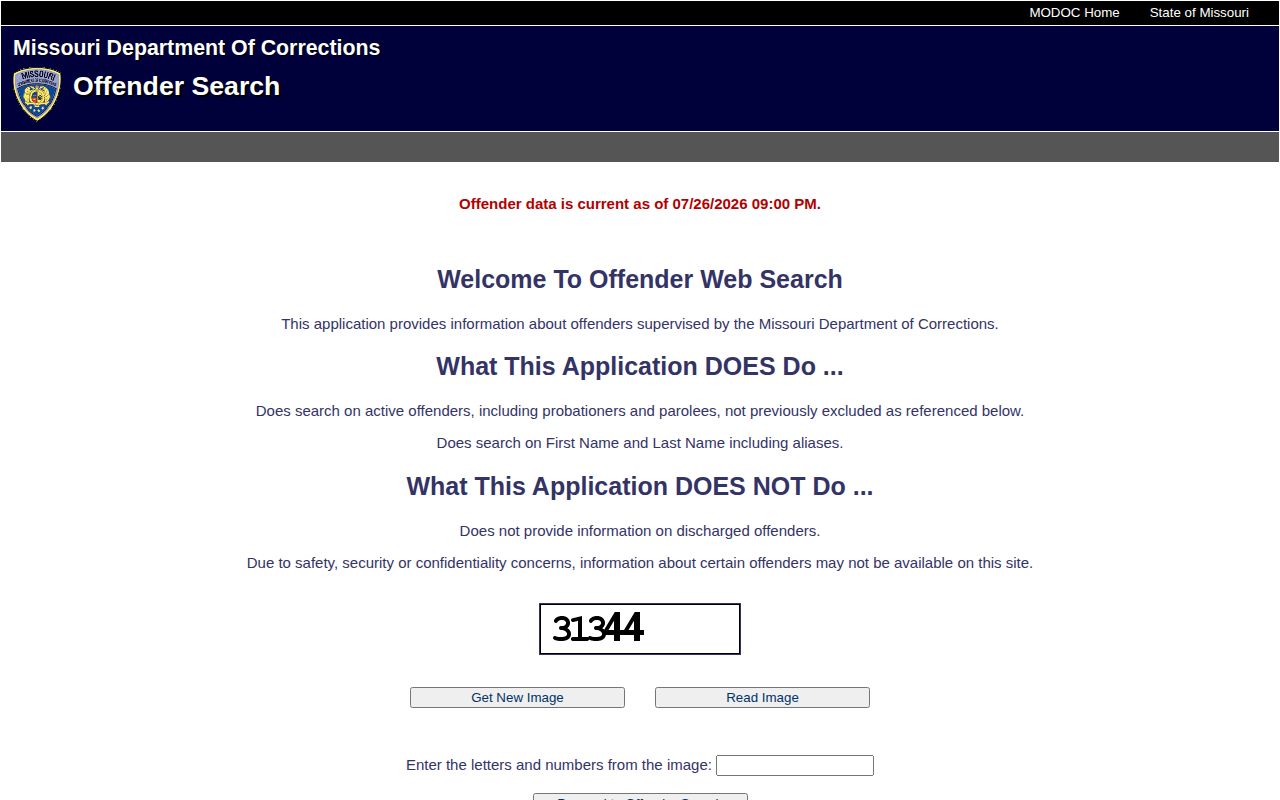
The official MODOC search form accepts a DOC ID or name, as shown below. A precise identifier reduces same-name mistakes. The form opens an active record; it does not overcome the welcome page's statement that discharged offenders are excluded.
A life-sentence or indeterminate code in a download must not be read as a date. MODOC documentation uses sentinel values such as 99999999, 88888888, and 66666666 for certain life, indeterminate, interstate, or assessment records. Ask MODOC what the code means for that record.
Linn County Jail Date Computation
A definite misdemeanor term is served in a county jail or another authorized institution until lawful release under RSMo § 558.011. For a Linn County term, use the signed judgment, sentence start, and all credited jail time. Macon County Jail performs the custody calculation because it houses Linn inmates. The Linn circuit record supplies the court authority.
No official Linn or Macon source reviewed publishes a local good-time formula or weekend-release policy. That absence matters. Do not assume that a rule from another Missouri county applies, and do not subtract a standard number of days. Ask Macon County Jail how the judgment and jail credit were applied. Direct a disputed credit entry to the court or counsel handling the case.
Local policy gap. No published county good-time or weekend-release formula was found, so the jail and court must confirm the calculation.
A release order can still be blocked by a detainer, warrant, or hold from another agency. A detainer is notice that another authority wants custody. The person may leave Macon's booking system through a transfer while never entering the community. Ask for the destination or authorizing agency when the distinction matters.
Linn County Missouri Sentence Rules
Missouri's conditional-release structure and minimum-term law are central to state calculations. RSMo § 558.011 divides many qualifying felony sentences into prison and conditional-release portions. For terms of nine years or less, the statute generally identifies one-third as the conditional-release term. It identifies three years for terms between nine and fifteen years and five years for terms over fifteen years, subject to statutory exceptions and Board procedures.
Conditional release is supervised release, not final discharge. The Parole Board may extend the conditional-release date through the statute's hearing procedure. Institutional rule violations can be part of that process. The exact conviction, sentence, and current Board record control.
RSMo § 558.019 contains minimum prison terms. Its 85 percent provision applies to a dangerous felony as defined in § 556.061. It is not a general rule for all prisoners. Other repeat-commitment percentages, offense qualifications, dates, and age-related provisions appear in the same law. Use the actual conviction statute and date rather than applying “85 percent” from a charge label alone.
Linn County Parole Eligibility Dates
Eligibility means the Missouri Parole Board may consider release. It does not mean release has been ordered. Under § 217.690, the Board has parole authority and applies assessment, interview, and eligibility rules. The Board can set another hearing one to five years later or establish a future release date after review. A hearing by itself proves neither result.
Questions about a specific release date or home plan should go to the institutional parole office or caseworker. Once a person leaves prison for a field assignment, MODOC's active search may continue to show the person because parolees remain active offenders. Final discharge is later and may remove the profile from the public active tool.
A county sentence and state parole should not be mixed. A person at Macon County Jail on a Linn matter may have no Board process at all. A transfer into MODOC custody begins the state route. Confirm the transfer before relying on state date fields.
Why Linn County Release Dates Change
A date can move because the legal or factual inputs change. Some changes alter the sentence calculation. Others do not change the end of one term but prevent release to the community. The table separates common factors documented in the Linn research.
| Factor | Possible effect |
|---|---|
| Corrected judgment or jail credit | Changes the sentence calculation |
| Concurrent or consecutive terms | Changes the combined minimum and maximum |
| Dangerous-felony minimum | May require 85 percent before early release eligibility |
| Conditional-release structure | Defines the supervised portion for a qualifying sentence |
| Parole Board decision | May set a future date or defer or deny release |
| Institutional rule violation | May support extension through the statutory process |
| New sentence, warrant, detainer, or hold | May block community release after one term ends |
| Transfer or data correction | May change location or the display without proving community release |
Ask which factor changed and which agency owns it. A corrected Linn judgment belongs in the court trail. MODOC owns its sentence computation and Board records. Another county or federal hold must be checked with that authority.
Note: A change in the displayed date may reflect corrected data, while a detainer may block release without changing one sentence.
Confirm Linn County Actual Release
For Macon jail custody, call the jail and check the Linn docket. Ask whether the person remains held, was released, or was transferred, plus the date, time, release type, and destination agency if those fields are open. For MODOC, compare the active profile, institutional caseworker information, Board decision, historical fields, and court judgment.
MOVANS can send a pending custody-change alert from a participating system. Registration steps and limits are explained on the Linn County VINELink Check page. An alert can lag, and a transfer alert does not mean release. Verify the event with the listed jail or MODOC before travel or other action.
For federal custody, use the BOP Inmate Locator and federal records. VINELink and the MODOC search are not federal sentence tools. Across all systems, record the source and its update time. A projected date is useful only when its agency, sentence, and current status are clear.
If an active MODOC search returns no match, a final discharge is possible, but it is not the only explanation. Recheck the DOC ID, name, and alias, then use the nightly historical file. Match the Linn cause number and sentence county before relying on a completed flag or release field. A court judgment or department record should resolve any conflict.
Note: Confirm the actual departure with the physical custodian because a projected date remains subject to later legal and administrative events.