
Linn County Parole and Probation
Missouri uses several forms of community supervision, and the source of the order is the key difference. Probation ordinarily comes from a circuit court judgment. It can follow a suspended imposition or suspended execution of sentence and permits the person to remain in the community under stated terms. Parole comes from the Missouri Parole Board after commitment to prison. Conditional release is the supervised part of a qualifying felony sentence under Missouri law. MODOC's Division of Probation and Parole may supervise all three, but that shared agency does not make the statuses interchangeable.
| Status | Who authorizes it | Best confirmation |
|---|---|---|
| Probation | Linn County circuit court | Case.net judgment and the assigned P&P office |
| Parole | Missouri Parole Board | Active MODOC profile, Board decision, and field office |
| Conditional release | Sentence law and Board administration | MODOC sentence record and field office |
| Final discharge | Court or MODOC/Board, based on status | Discharge or completion record |
Key terms. Parole is supervised prison release. Probation is a court-ordered community sentence. Discharge means supervision has ended.
Release from physical custody is not the same as final discharge. Someone assigned to a MODOC field office has left the institution but remains under supervision. In contrast, a person whose probation was discharged by the court or whose parole term ended may no longer appear in MODOC's public active search. The legal source and end record must be read together.
Verify Linn County Post-Release Supervision
The official MODOC Offender Web Search covers active offenders, including people on probation and parole. It expressly excludes discharged offenders. Search by DOC ID when known because that permanent number is more precise than a name. If only a name is available, compare the date of birth, Linn cause number, offense, sentence county, and assigned place before treating the result as the correct person.
- Search the MODOC Offender Web Search and note its data-current time.
- Open the matching profile and distinguish an institution assignment from a field-office assignment.
- Search Case.net under Linn County for the judgment, probation order, violation entries, or discharge.
- Call the assigned MODOC field office with the full name, DOC ID, date of birth, and Linn case number.
- If no active result appears, use the MODOC historical file or request the discharge record. Do not treat a blank result as proof.
MODOC states that staff may confirm whether a person is under supervision and, subject to law and policy, provide the present offense, sentence and judgment, county, supervision term, standard or special conditions, supervising officer and office, custody or bond status, parole or conditional-release date, Board decision, and prior convictions. The Linn County released-inmate search path explains how Macon jail custody and the Linn court case fit beside this state check.
The active profile is strongest when paired with the court record. A Linn judgment establishes whether the court ordered probation, while a Board decision establishes parole after a prison term. An assigned place marked as a field office supports community supervision. It is not the same as final discharge. Note the profile's update time, since a new order or transfer may not appear at once.
When the active search has no result, check spelling and aliases before moving to the historical MODOC file. That nightly file covers people who are or have been under department supervision and includes the DOC ID, Linn cause number, sentence county, completed flag, and probation data. It can locate an older term, but the court, Board, or department discharge record remains the best proof that supervision ended.
Note: A missing active profile may indicate final discharge, a name mismatch, or delayed data, so obtain an affirmative source record.
Linn County Supervision in Brookfield
Research Section 19 identifies a useful local layer that statewide explanations can hide. MODOC District 2S is in Brookfield, within Linn County. It is the practical office for confirming an active assignment, the supervising office, and available details about a current parole or probation term. General MODOC guidance lists field-office hours as 8:00 a.m. to 5:00 p.m., Monday through Friday, except state holidays. Verify hours before making a trip.
The official MODOC office listing is the source for this address and phone. Its Brookfield entry is shown in the captured state listing below. The image helps identify the office, while a call to District 2S confirms whether the listing and a person-specific assignment remain current.
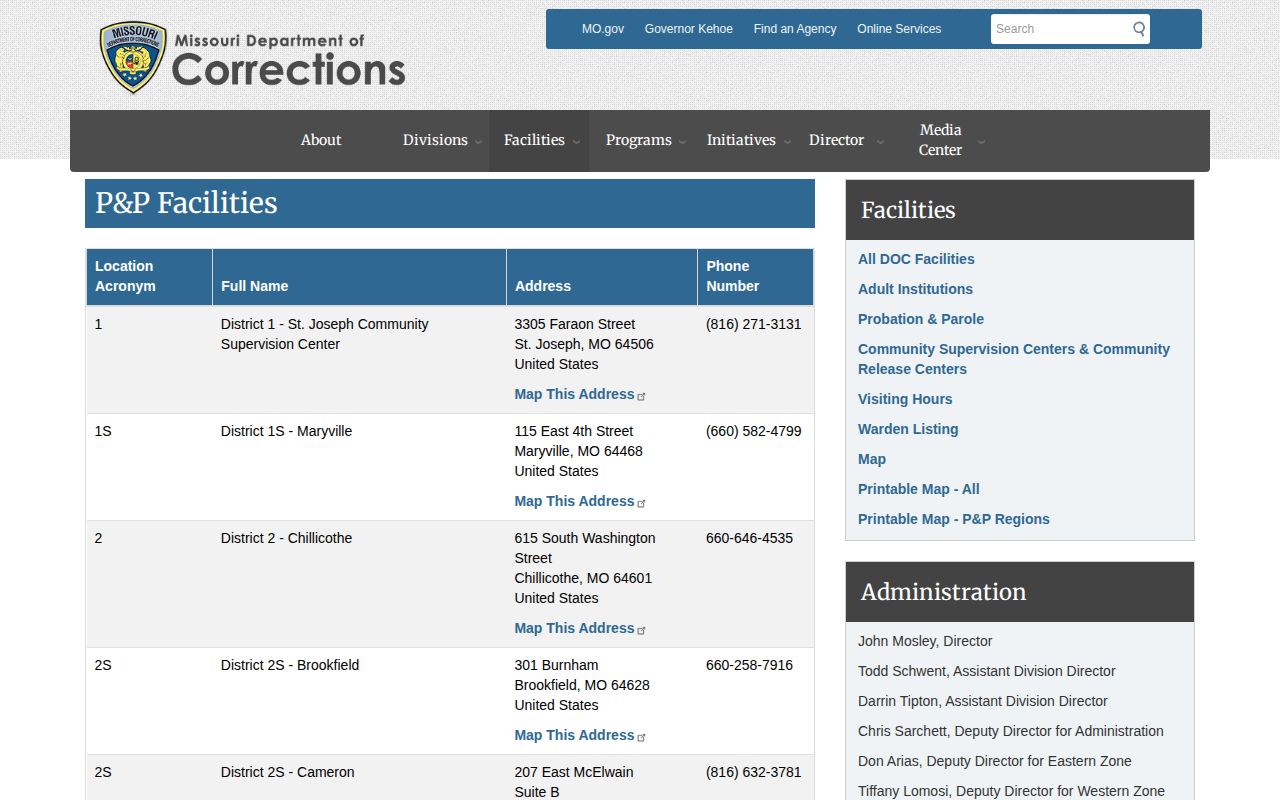
Final discharge may require a different route. The public active search stops returning discharged people. Ask for the discharge entry through the proper MODOC custodian, use the historical offender file, or review the Linn County court docket when probation ended by court order.
Linn County Parole Hearing Records
A parole hearing is an eligibility step, not a release order. The Missouri Parole Board schedules hearings under sentence rules and its current guidance. After a hearing, it may set another hearing in one to five years or establish a future release date. Missouri's official parole-hearing page says the decision process can take about eight to twelve weeks. The written notice controls, not the fact that a hearing occurred.
No official public person-by-person hearing calendar or decisions database was found in the state source sweep. Use the Missouri Parole Board page for current rules, schedules, and process links. A person-specific decision may be requested from the proper Board or MODOC custodian. Questions about a date or home plan belong with the institutional parole office or caseworker.
RSMo § 217.690 governs Board authority, assessment, interviews, and eligibility calculations. RSMo § 558.019 can require a minimum prison term before eligibility. Its 85 percent provision applies to a dangerous felony as defined by law, not to every Missouri sentence. Consecutive terms and offense-specific rules can also affect when the Board may consider release.
Note: A scheduled parole hearing confirms review eligibility, not approval, a release date, or final discharge from Missouri supervision.
Linn County Supervision Violations
Conditions are rules attached to supervision. They can be standard terms that apply broadly or special terms tied to the court or Board order. A violation allegation does not itself show that supervision ended. It may lead to a hearing, a sanction, a warrant, arrest, or return to custody. The current MODOC record and the case or Board entry provide the context.
An absconder is a person alleged to have stopped reporting or evaded supervision. It does not mean that the person finished parole or probation. Verify that status with District 2S or the assigned office. Linn County has a public warrant channel, but a county warrant list is not a full MODOC absconder list and does not prove where anyone is located.
Verification point. A warrant or absconder label is not a custody location. Confirm it with the issuing or supervising agency.
If Linn authorities arrest a person on a county warrant, Macon County Jail may become the physical custodian because Linn County has no operating jail. A parole violation can instead result in MODOC custody. Those paths require different records, even though both can follow a period of community supervision.
Linn County Parole Notice Channels
Missouri offers more than one notification channel. MOVANS and VINELink can provide custody-event alerts from participating systems. MODOC's Office of Victim Services is a separate statutory route for qualifying crime victims. Under § 595.209 and the agency's process, it may provide notice of parole hearings, results, release to the community, escape, and death after the required registration.
The Office of Victim Services can be reached at 573-526-6516 or victims@doc.mo.gov during its listed weekday business hours. That channel is not interchangeable with a general VINELink alert. A custody notification is also not a Board decision. Read the event label and verify it through the record that authorized the change.
Linn County Supervision Discharge
Supervision ends through a discharge or completion record, not because a profile vanished or a person stopped appearing on a jail list. For probation, review the Linn County Case.net docket for completion, discharge, or a later court order. For parole and conditional release, use the MODOC or Board record. MODOC's historical nightly file includes a sentence-completed flag and records for people who are or have been under department supervision.
A live search failure has several possible causes. The name may be misspelled, the person may use an alias, the record may not yet be updated, or final discharge may have removed it from the active tool. Match the DOC ID and Linn cause number in the historical path. Then request the source record if the end date matters.
Probation discharge does not rewrite the original court history by itself. Parole discharge ends that supervision term but is distinct from the earlier release from prison. Keep the prison-release date, field-supervision period, and final-discharge date separate when reading a timeline.
Note: The supervising office can confirm an active assignment, while a court, Board, or MODOC discharge record proves the term ended.